
Trump ‘stuck’ in Iran war stalemate
“Trump appears to be stuck,” Eurasia Grp’s Gregory Brew. “While this pace of operations is manageable, it likely won’t be decisive. Iran can absorb US strikes without shifting its position on Strait.”
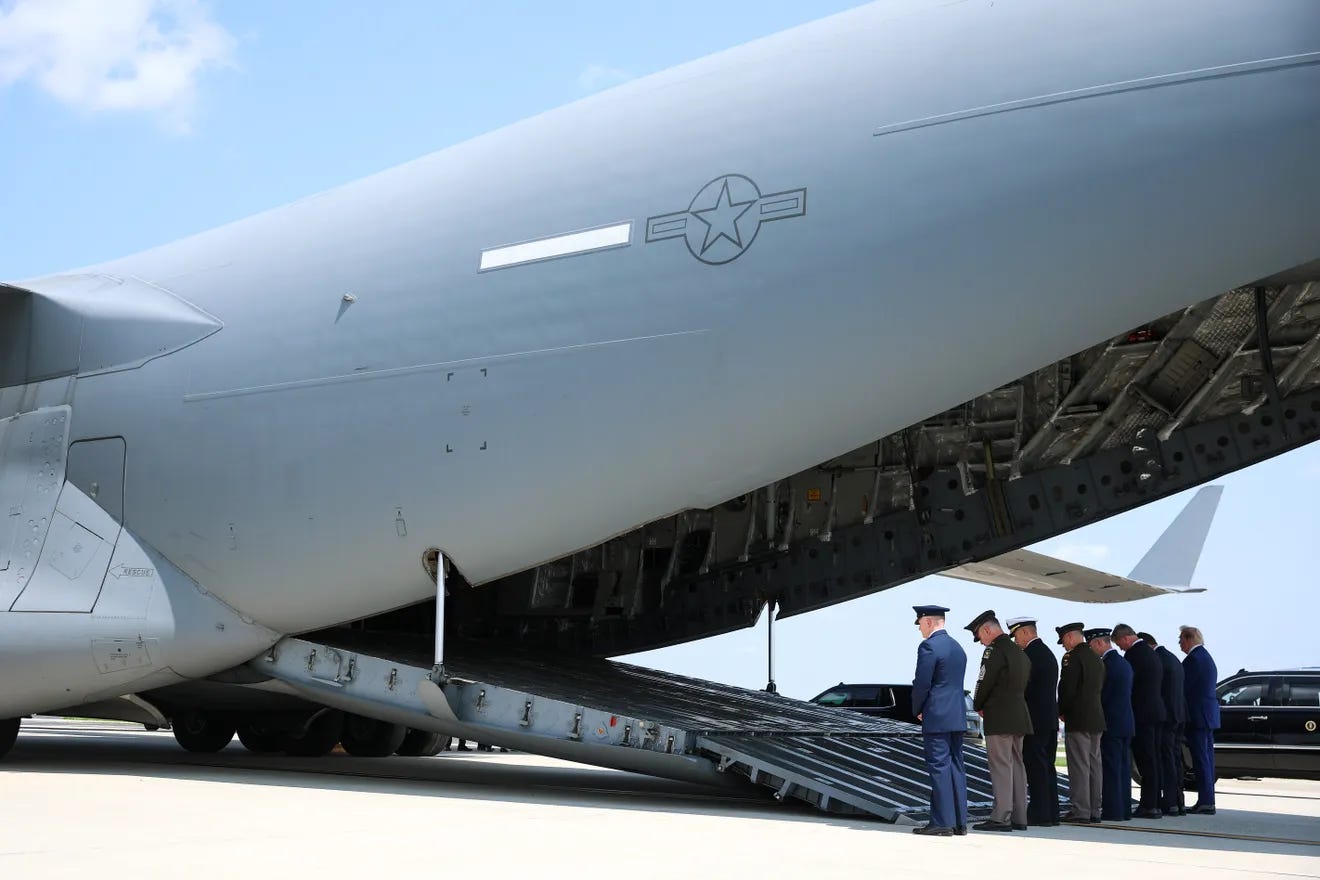
As he traveled to Dover, Delaware, today to witness the dignified transfer ceremony of the remains of four U.S. soldiers killed in connection with Iranian retaliatory strikes on U.S. posts in Jordan and Iraq last weekend, President Trump appeared to be doubling down on the bombing of Iranian military and some infrastructure targets. Iranian officials, in turn, vowed today to retaliate in kind, including against countries assisting the United States in any way.
“From this point forward, any time the Islamic Republic of Iran shoots at a ship in the Strait of Hormuz…the United States will bomb and destroy one bridge or power plant,” Trump wrote on Truth Social.
“Our defense doctrine is clear: eye for an eye,” Iranian Foreign Minister Abbas Araghchi responded on Twitter.
“Any aggression against Iran, including our infrastructure, will compel a powerful and decisive response. Those who contribute to such aggression, whatever the kind of support, will also be considered as legitimate targets.”
Trump appears frustrated that Iran has not surrendered, said former U.S. Iran negotiator Robert Malley.
“President Trump, frustrated that Iran will not bend to his will, is once again threatening war crimes in pursuit of an unlawful, unjustified war whose purpose has become to remedy the very problems it created,” including “to reopen a waterway that was not closed before he launched it,” Malley wrote on Twitter commenting on Trump’s Truth Social threat. “It’s the theater of the absurd, but one in which blood is shed.”
“It’s a bombing campaign NOT in search of a strategy,” commented Rosemary Kelanic, director of the Middle East program at the Defense Priorities think tank, in evident exasperation.
The U.S. administration appears to be expanding attacks to some Iranian civil targets, like bridges and energy industry sites, as a form of economic warfare, Kelanic told me.
“It does seem like the U.S. is going more obviously against… civil targets, things like oil and energy industry targets,” Kelanic said in an interview. “The targets that they’re firing on are more like the traditional targets of economic warfare. So they’re trying to pressure the regime, not just by attacking its military capabilities, but by attacking its civilian economy.”
But the expanding US air war, now in its 12th day since the collapse of the US-Iran 60 day ceasefire agreement known as the Islamabad Memorandum of Understanding, is unlikely to change the Iranian regime’s behavior or calculus, said Kelanic.
“It’s cheap for [Iran] to field drones and missiles,” she said. “We know they have 1000s of them, so we’re not going to be able to take away their capabilities. It’s a question of can we take away their desire to attack. And because they’re so threatened, and this is an existential war for them, they are willing to pay high costs. They’re willing to absorb a lot of punishment.”
“And they’re probably more willing to absorb U.S. punishment than Saudi Arabia and Kuwait, etc., are willing to absorb Iranian punishment,” she continued. “So I think Iran basically has escalation dominance when it comes to this. They can inflict the same kind of pain on the Gulf, and that same pain hurts more unit per unit for the Gulf because the Gulf is not used to the economic privation that Iran is used to, and their security was not at stake in the same kind of way that Iran’s is by being the subject of a regime change war by the U.S.”
Trump ‘stuck’
“Trump appears to be stuck,” Gregory Brew, senior Iran and energy analyst at the Eurasia Group, told me by email today. “He’s comfortable continuing the daily air strikes on Iranian military targets and the ongoing effort to degrade Iran’s capabilities in the Strait of Hormuz, but appears unwilling to significantly escalate against more vulnerable targets, likely out of concern that doing so would trigger more destructive Iranian retaliation in the Persian Gulf.”
“But while this pace of operations is manageable, it likely won’t be decisive,” Brew continued. “Iran can absorb US strikes without shifting its position on the strait. Its capabilities to harass shipping are very resilient and won’t be seriously degraded, at least not on a reasonable time frame.”
“Trump has nothing but bad options,” he said. “He can stay the course and hope that weeks of grinding air strikes will force the Iranians to make concessions. He can escalate and risk a much deadlier, more destructive conflict-- again, without much confidence that the Iranians will cave. Or he can return to the negotiating table and try to strike another deal.”
“Trump has driven the US into a dead end,” former U.S. diplomat Daniel Serwer wrote. “A return to negotiation will save a lot of lives and money. But it will have to be a negotiation over the terms of tolling. That is a big loss from the US, but it’s where we are at.”
Diplomacy ‘dead’ for now
But diplomacy appears at a standstill at the moment.
“The Qataris are trying, but it doesn’t seem to have any momentum,” Ali Vaez, director of the Iran program at the International Crisis Group, told me.
“I think diplomacy is dead,” Kelanic said. “And I think if it wasn’t dead already, the announcement that Trump is going to help the Saudis with nuclear capabilities I think completely killed it.
“Because from Iran’s perspective, this whole war is being fought because we didn’t want Iran to enrich uranium,” she said. “And then the U.S. turned around and said, in the middle of a war, that we’re going to give their regional rival potentially the ability to enrich uranium. And so that has to that has to be completely shocking to Iran. That has to make them believe all along that Trump was never negotiating in good faith, right? Because all the arguments that Trump made about why Iran shouldn’t have enrichment should apply to the Saudis. Apparently, they don’t.”
**